


Navigational Leadership
Navigational Leadership: Learning Through Others
Develop command, delegation, and oversight before and after promotion with this specialized training model. Safe navigation demands more than technical competence; it requires shared awareness, clear ownership, active monitoring, and timely challenge across the entire bridge team.
The Training Model:
A Progressive Cycle
Transition seamlessly from simply doing the work to leading the work. This framework relies on a structured, five-step progressive cycle from observation to command.

Delivery Across Every Career Stage:
Before Promotion
Lead briefings, allocate roles, organize watch teams, and make supervised decisions under real-world bridge conditions.
Simulator Scenarios
Test operational priorities, delegation thresholds, team communication, risk anticipation, and workload management.
First Contracts at Rank
Provide ongoing coaching, Chief Officer stabilization, and targeted feedback to reinforce early command judgement.


IMPORTANCE OF THIS TRAINING
Why Learning Through Others Matters
Safe bridge operations depend on whether an entire watchkeeping team can think, communicate, and act as one unit under demanding conditions.

The Command Gap
Technical competence does not guarantee effective delegation, supervision, or command awareness.

The Bridge Reality
Safe navigation requires shared awareness, clear ownership, active monitoring, and timely challenge—demanding that delegation and oversight be trained as operational skills.

The Pressure Point
In demanding conditions, effective leaders engage the team before workload rises rather than absorbing stress alone.

Delegation as Control
Clear task allocation does not surrender command; it strengthens operational control, reinforces officer ownership, and preserves the Master's wider situational picture.
Observable Assessment Criteria
Briefing Quality
Intent, team roles, abort criteria, and navigational hazards are explicitly understood.
Delegation & Oversight
Tasks are allocated to the right personnel at the right time while maintaining the wider picture.
Intervention Timing
Senior officers step in to guide or correct actions before developing risks become unrecoverable.
Debriefing Effectiveness
Converting operational experiences and weak signals directly into future bridge behaviours.
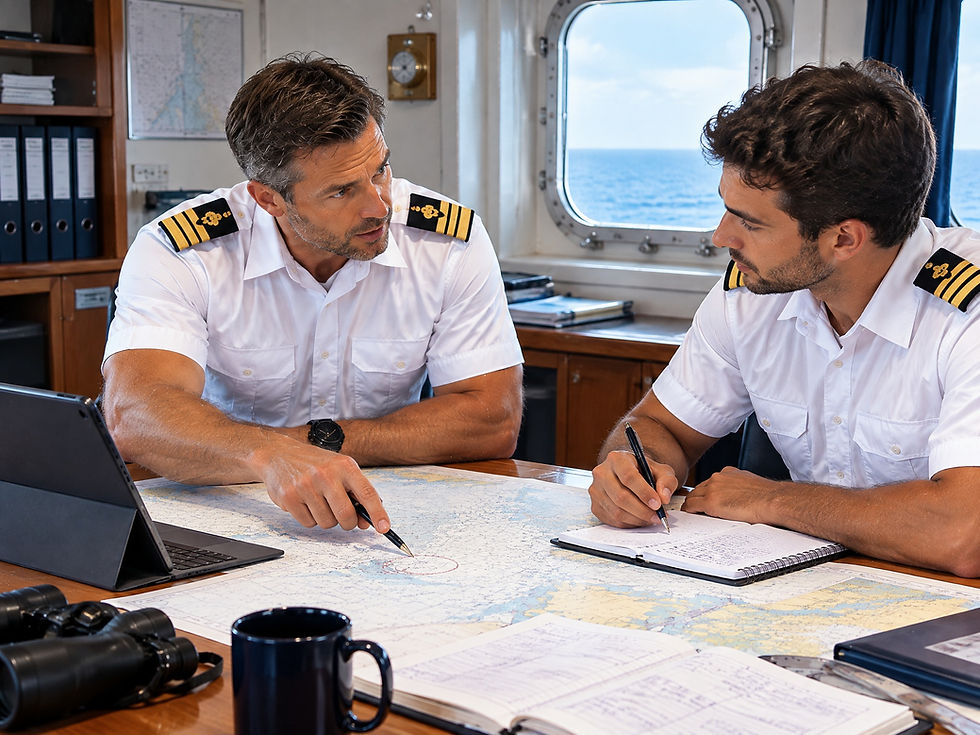
Everyday Operational Behaviours
Before the Passage
Share the plan, hazards, operational intent, abort points, and challenge triggers to establish a common mental model.
During Navigation
Report developing risk early, verify critical data independently, and cross-check continuously within an atmosphere of psychological safety.
After the Event
Conduct structured operational debriefs to evaluate what was seen, what was missed, and what must be adapted for future passages.

What Should Be Assessed
Practical Bridge Behaviours
Training focuses strictly on observable bridge-team behaviour, turning separate watchkeepers into one thinking team supported by psychological safety. Expect your officers to master:
How the Model is Delivered:
Support During First Contracts
This standard is delivered through pre-promotion supervised decisions, simulator scenarios, and targeted coaching during first contracts at rank. The Master retains responsibility and sets intent, the Chief Officer supports bridge leadership, and the OOW owns delegated tasks. Safe command makes the whole team think, contribute, and act together.

Master
Set intent, hold the wider picture, confirm priorities and intervene.

Chief Officer
Support bridge leadership, strengthen challenge and mentor future Masters.

OOW / Bridge Team
Own tasks, monitor risk and keep the Master informed.
